
2. Check Whether the Product Range Matches Your Project
1. Define the Application Before Comparing Manufacturers
A reliable manufacturer should begin by understanding the application rather
than immediately recommending the cheapest available box. Enclosures used for
indoor terminal connections, outdoor CCTV equipment, industrial machinery and
power distribution systems face different environmental and installation
requirements.
Before requesting a quotation, determine the following project conditions:
- Indoor, sheltered outdoor or fully exposed outdoor installation
- Expected exposure to rain, dust, humidity or temporary water accumulation
- Direct sunlight and ultraviolet exposure
- Operating temperature and temperature variation
- Possible contact with oil, chemicals, salt or industrial contamination
- Internal component dimensions and heat generation
- Required cable entry directions and cable diameters
- Frequency of inspection and maintenance
- Required IP, IK or other project-specific ratings
Buyers who are uncertain about the required protection level can first review
this guide to
choosing an IP-rated waterproof junction box
.
It explains the practical differences among IP65, IP66 and IP67 enclosure
applications.
A capable supplier should offer more than one enclosure style. Different
structures are required for cable connections, circuit protection, control
buttons, terminal blocks and frequently maintained electrical equipment.
Reviewing the manufacturer's
waterproof electrical enclosure product range
helps buyers determine whether the supplier can support current and future
projects without requiring a different source for every application.
Application Requirement | Recommended Enclosure Structure | Important Selection Factors
Outdoor cable connection | Screw-cover waterproof junction box | Sealing, cable glands, internal space and mounting method
Equipment requiring regular maintenance | Hinged enclosure with secure latches | Opening direction, hinge durability and gasket compression
Circuit breaker installation | Waterproof distribution box | DIN rail space, transparent cover and cable entry layout
Industrial wiring transition | Terminal block junction box | Terminal quantity, conductor size and maintenance access
Local machinery operation | Pushbutton control station | Button quantity, operator size and protective cover
For example, a sealed
IP67 outdoor waterproof junction box
may be suitable for exposed cable connections, while an
IP66 hinged waterproof junction box
is often more convenient when technicians need repeated access to internal
components.
Projects involving circuit breakers and modular components may require an
IP65 waterproof electrical distribution box
,
while organized conductor branching may be better served by a
waterproof terminal block junction box
.
3. Request Complete Dimensional Information
External dimensions are not enough to confirm whether an enclosure will fit
an electrical assembly. Internal ribs, screw bosses, wall thickness, hinges
and gasket channels all reduce the available installation space.
A professional product drawing should clearly identify:
- Overall external dimensions
- Usable internal length, width and depth
- Cover and base dimensions
- Internal mounting bosses
- Mounting hole locations
- Wall thickness in machining areas
- Hinge and latch positions
- Gasket channel dimensions
- Recommended cable entry areas
Buyers should compare these dimensions with the actual PCB, terminal,
transformer, contactor, circuit breaker or DIN rail assembly. Additional
clearance must also be reserved for wiring bends, cable glands, connectors
and maintenance access.
When dimensional tolerance is critical, request a sample and physically
install the intended components before approving a production order.
4. Verify IP Claims for the Exact Product Configuration
IP ratings are frequently used in product marketing, but buyers should confirm
whether the stated rating applies to the exact enclosure model, material,
gasket and assembled configuration being purchased.
Ask the manufacturer the following questions:
- Which specific model was evaluated or tested?
- Does the rating apply to both opaque and transparent cover versions?
- Which gasket material and assembly method were used?
- Does the rating remain applicable after cable-entry machining?
- Which cable glands or sealing components are recommended?
- Can relevant reports or certification information be provided?
CNC openings, incorrectly sized cable glands and poor field installation can
reduce the sealing performance of an otherwise well-designed enclosure.
Therefore, the enclosure, cable entry and sealing accessories should be
evaluated as one complete system.
Buyers can review BOWO Electric's available
qualification and certification information
when conducting a supplier assessment. The applicable documentation should
still be confirmed for the exact model included in the purchase order.
5. Evaluate Materials According to the Environment
Material selection influences impact resistance, weight, appearance,
temperature performance, outdoor durability and production cost. The correct
material should be selected according to the installation environment rather
than price alone.
ABS Enclosures
ABS is commonly used for electrical enclosures because it provides a practical
balance of mechanical strength, dimensional stability, manufacturability and
cost. It can be suitable for many industrial control, cable connection and
general equipment applications when the material formulation matches the
operating environment.
Polycarbonate Components
Polycarbonate is often selected for transparent covers, viewing windows and
applications that require higher impact resistance. A transparent cover can
allow technicians to inspect indicators, circuit breakers or control elements
without opening the enclosure.
Metal Enclosures and Components
Metal enclosures or metal latch configurations may be considered where
mechanical strength, installation structure or repeated opening requirements
are particularly important. Corrosion exposure and surface treatment should
also be evaluated.
Buyers should ask for the declared material type, available flame-retardant
options, outdoor suitability and any project-specific material documentation
before approving the order.
6. Inspect Manufacturing and Quality-Control Capabilities
Product consistency depends on the complete manufacturing process, not only
on the original enclosure design. Injection molding stability, dimensional
inspection, gasket assembly and accessory control all affect the quality of
the finished product.
A supplier assessment should cover:
- Raw-material identification and storage
- Injection molding process control
- Mold maintenance procedures
- Dimensional measurement equipment
- Surface and appearance inspection
- Gasket installation and sealing inspection
- Latch, hinge and screw assembly
- CNC machining accuracy
- Accessory quantity verification
- Batch identification and packaging inspection
A serious manufacturer should be able to explain how these processes are
managed instead of relying only on general statements such as “high quality.”
Factory equipment, manufacturing environment and service capabilities can be
reviewed on the
BOWO Electric factory introduction
.
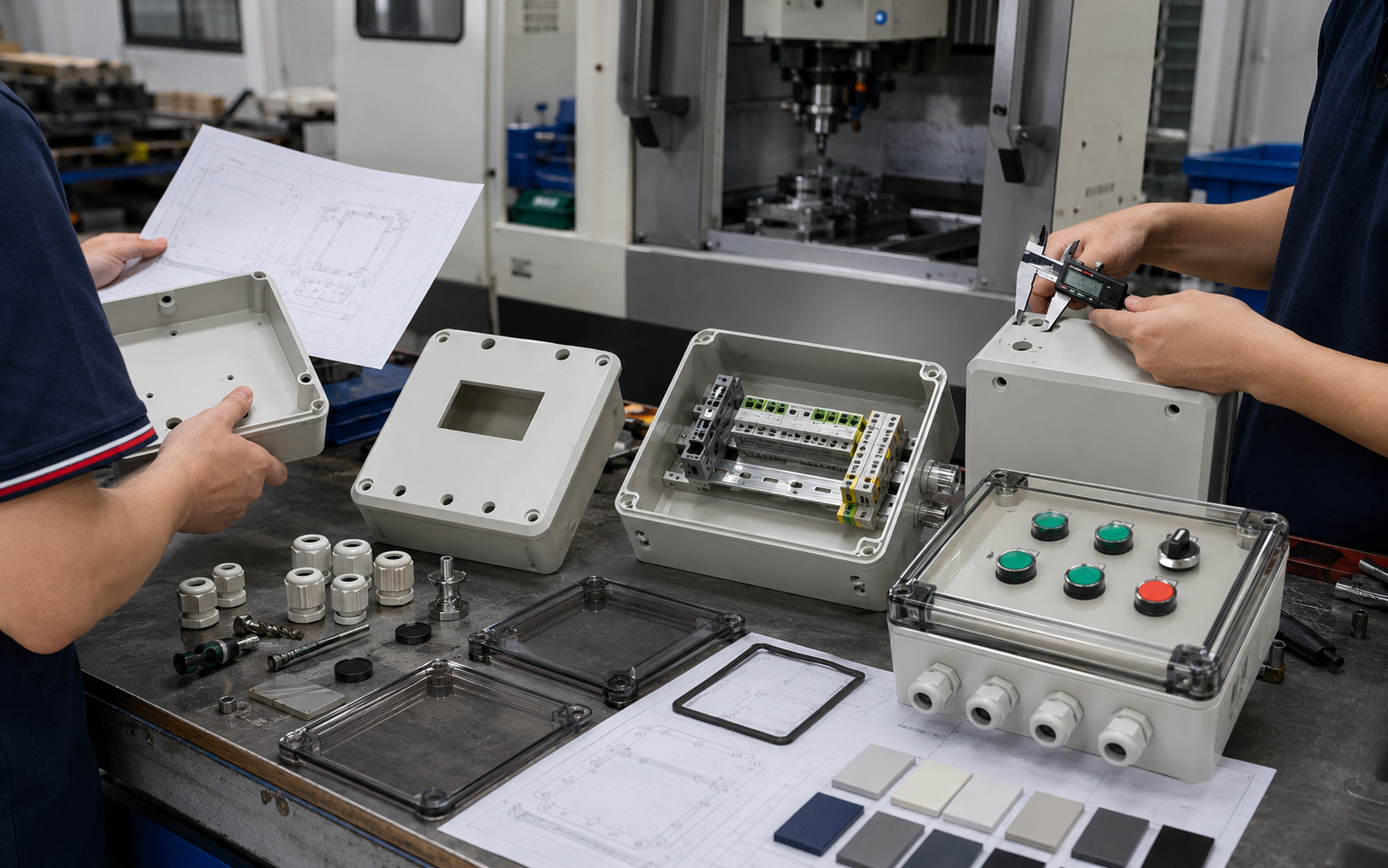
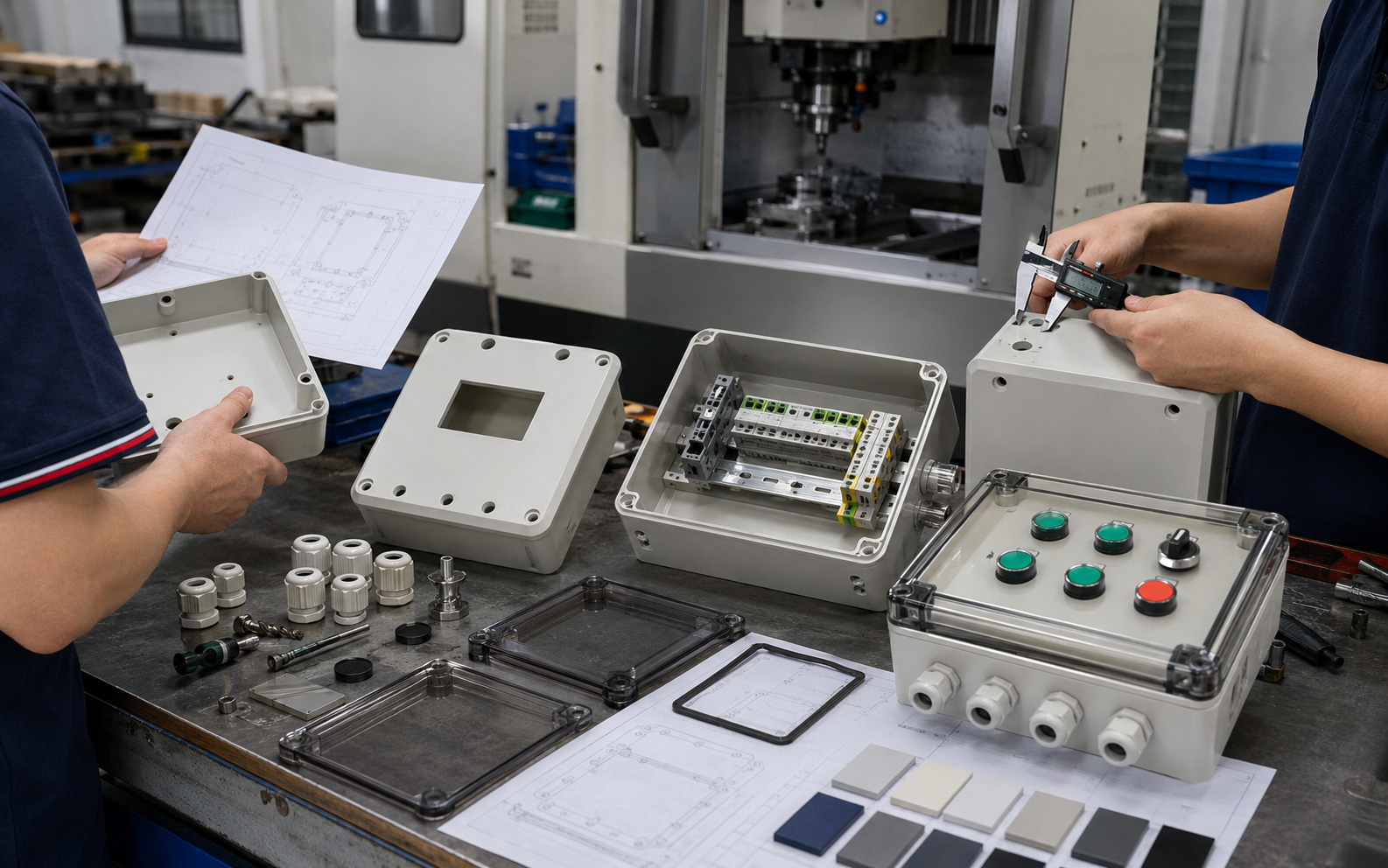
7. Confirm Whether Customization Is Completed In-House
Many OEM projects do not require a completely new enclosure mold. Existing
enclosure platforms can often be adapted through CNC machining, printing,
accessory installation or color customization.
Common customization requirements include:
- Cable gland holes
- Connector and socket openings
- Pushbutton and indicator holes
- Display or transparent windows
- DIN rail and mounting plate installation
- Terminal block assembly
- Laser marking
- UV printing
- Logo and model identification
- Custom colors and packaging
Confirm whether these operations are performed and inspected by the enclosure
manufacturer or transferred to an unrelated subcontractor. In-house control
can simplify technical communication and reduce the risk of inconsistent
machining or surface treatment.
For a detailed explanation of customization methods, drawings and development
steps, see the guide to
customizing waterproof junction boxes for OEM projects
.
8. Assess the Supplier's Engineering Communication
The quality of a quotation often reveals the quality of the supplier's project
management. A professional response should clearly identify what has been
included, what still requires confirmation and which technical risks may affect
the proposed solution.
A complete technical quotation should specify:
- Recommended enclosure model and dimensions
- Material and cover configuration
- Included accessories
- Machining or printing requirements
- Applicable product rating
- Sample cost and sample preparation process
- MOQ and production quantity
- Tooling cost when a new mold is required
- Packaging method
- Production lead time
- Quotation validity and trade terms
Be cautious when a supplier confirms every technical requirement immediately
without reviewing the drawings, cable entries, internal layout or environment.
Engineering questions are not an inconvenience; they are often evidence that
the supplier is evaluating the project carefully.
9. Review Real Installation Cases
Product photographs show what an enclosure looks like, but application cases
demonstrate how the enclosure is selected, installed and maintained in an
operating environment.
Relevant examples on the BOWO website include a
pushbutton control station installation for an automated factory
,
an
IP67 waterproof junction box used with roadside CCTV equipment
and a
waterproof junction box installation for a residential barrier gate
.
When reviewing any case study, examine the installation environment, cable
direction, mounting structure, maintenance requirements and enclosure
configuration. These details are more useful than a general statement that
the product is “widely used.”
10. Compare Total Project Cost, Not Only Unit Price
The lowest enclosure price does not always create the lowest total project
cost. An enclosure that requires manual drilling, additional brackets,
replacement gaskets or repeated assembly adjustments can increase labor and
delay production.
Total cost may include:
- Enclosure purchase price
- CNC machining
- Printing and identification
- Internal accessories
- Assembly labor
- Rejected or reworked products
- Additional packaging
- Installation time
- Future maintenance
- Production interruption caused by inconsistent supply
A slightly higher unit price may be justified when the supplier provides
accurate machining, pre-installed accessories, stable batch quality and
responsive technical support.
11. Use a Sample Approval Process
For customized or technically important projects, sample approval should be
completed before mass production. The sample should represent the expected
production configuration, including machining, color, accessories, printing
and packaging where applicable.
During sample evaluation, check:
- Overall and internal dimensions
- Component fit and installation clearance
- Cable gland and connector fit
- Hole location and machining quality
- Gasket continuity and compression
- Cover opening and closing
- Latch or screw operation
- Mounting stability
- Logo position and printing quality
- Packaging protection
Record the approved sample version, drawing number and revision date. Any
subsequent technical change should be documented before production begins.
12. Prepare a Complete RFQ for an Accurate Quotation
A clear request for quotation helps the manufacturer recommend the correct
enclosure and reduces repeated communication. Include as much of the following
information as possible:
- Application and equipment type
- Installation country and operating environment
- Required IP or IK protection level
- Preferred enclosure material
- Required external or internal dimensions
- Internal component drawing or photograph
- Cable quantities and cable diameters
- Cable-entry locations
- Required accessories
- Logo, printing or color requirements
- Estimated order quantity and annual demand
- Required delivery schedule and destination
Drawings do not need to be complex during the initial inquiry. A marked
photograph, PDF drawing or dimensioned sketch can often provide enough
information for the manufacturer to begin evaluating the project.
Frequently Asked Questions
What information should I send to an enclosure manufacturer?
Send the required dimensions, application environment, internal component
layout, cable sizes, cable-entry locations, expected quantity and required
protection level. Include drawings or equipment photographs whenever possible.
Can a standard waterproof enclosure be customized?
Yes. Standard enclosures can often be customized through CNC machining,
cable-entry preparation, printing, laser marking, accessory installation and
color changes. This is usually more economical than developing a new mold for
low- or medium-volume projects.
Does an IP67 enclosure support permanent underwater installation?
IP67 generally relates to temporary immersion under defined test conditions.
It should not automatically be interpreted as approval for permanent underwater
use. The exact product specification, installation method, cable entries and
application conditions must be confirmed.
Should I order a sample before mass production?
A sample is strongly recommended when the project includes custom machining,
internal components, branding, unusual cable entries or specific dimensional
requirements. It allows the complete assembly to be checked before bulk
production.
When should I choose a hinged enclosure?
A hinged enclosure is useful when technicians need repeated access for
inspection, operation or maintenance. A screw-cover enclosure may be more
suitable for installations that are rarely opened and require a compact,
permanently closed structure.
Final Manufacturer Evaluation Checklist
Before approving a waterproof electrical enclosure supplier, confirm that the
manufacturer can provide:
- A product structure suitable for the actual application
- Reliable dimensional drawings and technical data
- Clear model-specific protection information
- Appropriate material options
- Stable manufacturing and inspection processes
- Controlled CNC and branding services
- Engineering communication before production
- Samples for customized projects
- Documented production revisions
- Suitable packaging and delivery support
The best manufacturing partner is not simply the supplier with the largest
catalogue or the lowest quotation. It is the supplier that understands the
application, identifies technical risks, provides a practical solution and
maintains consistent quality throughout repeated production.
Request a Waterproof Electrical Enclosure Recommendation
BOWO Electric supplies waterproof junction boxes, distribution boxes,
terminal boxes, pushbutton enclosures and customized electrical protection
products for industrial, outdoor and OEM applications.
Send your enclosure dimensions, internal layout, cable-entry requirements,
operating environment and estimated quantity. The technical team can review
the information and recommend a suitable standard or customized enclosure
configuration.
Contact BOWO Electric to Request a Project Quotation