
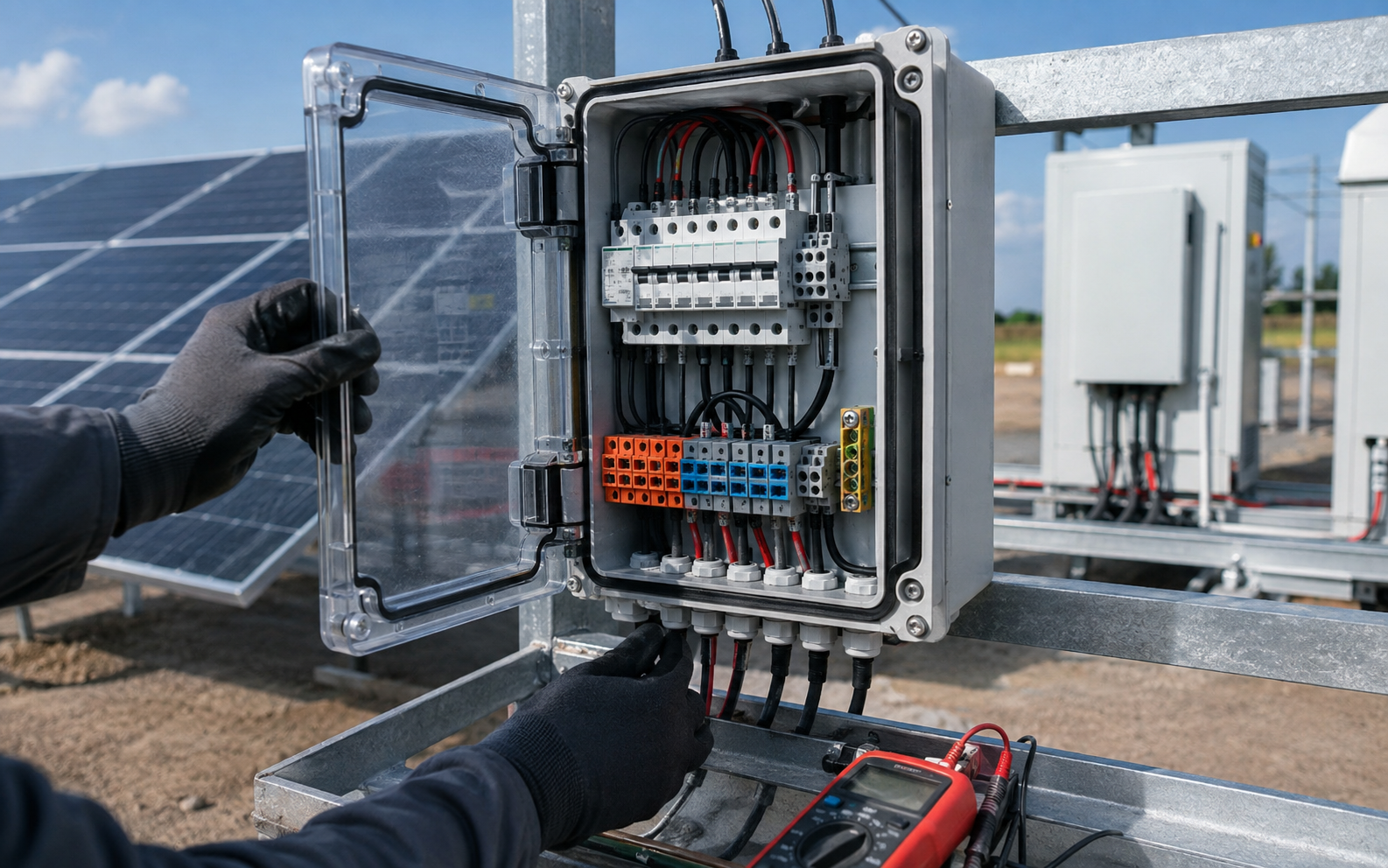
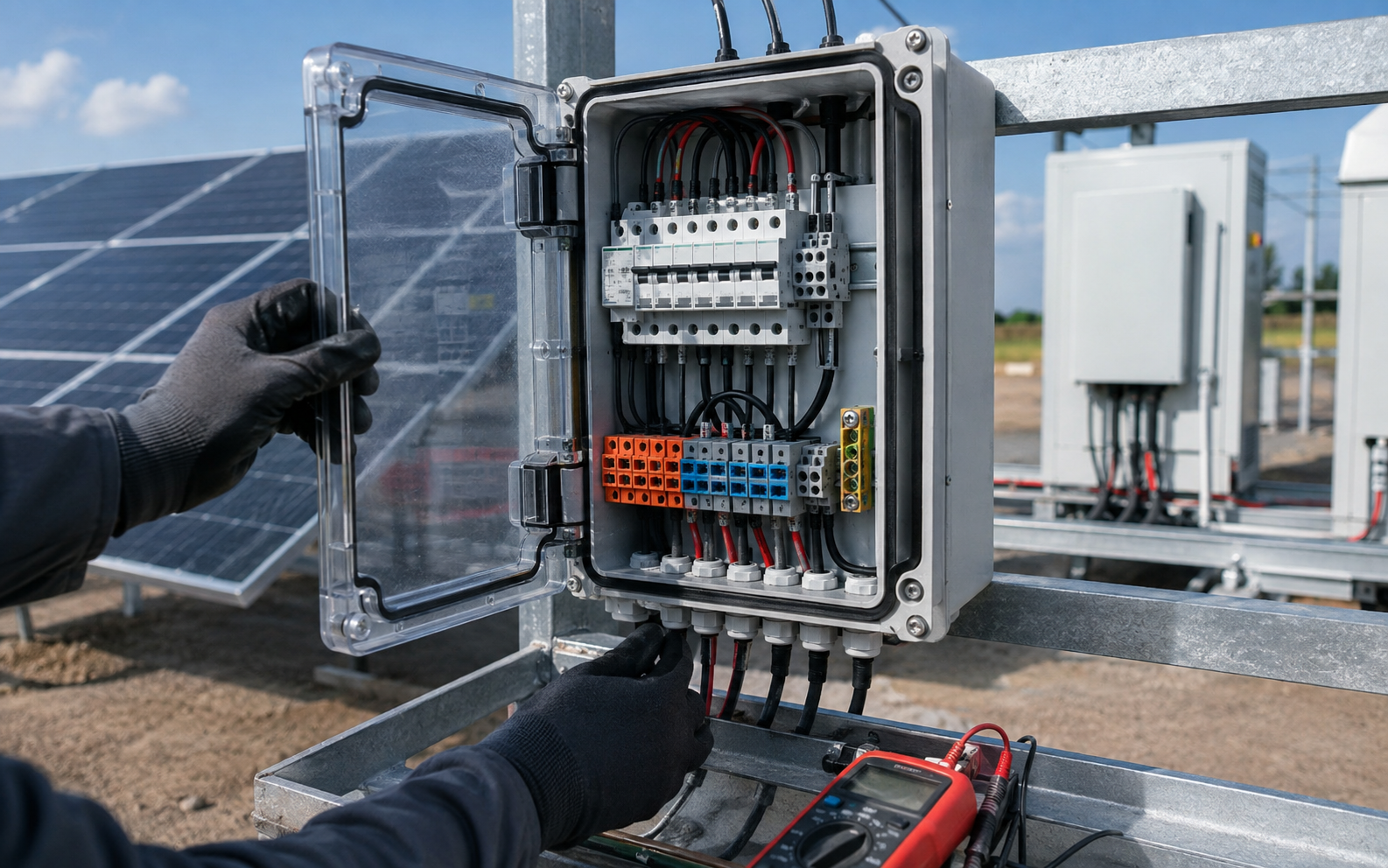
Where Are Waterproof Enclosures Used in Solar and Energy Storage Systems?
Solar photovoltaic and battery energy storage systems contain numerous electrical
connection points that may be installed outdoors, beside equipment cabinets or
across distributed project locations. These connections can be exposed to rain,
dust, humidity, ultraviolet radiation, temperature changes and maintenance activity.
A correctly selected waterproof electrical enclosure helps protect terminals,
circuit breakers, communication modules, monitoring devices and cable connections.
However, enclosure selection should not be based only on external dimensions or a
published IP rating. Project buyers must also consider the material, internal layout,
cable-entry design, installation orientation and long-term maintenance requirements.
This guide explains how EPC contractors, solar equipment manufacturers, energy
storage integrators, electrical distributors and project procurement teams can
evaluate waterproof enclosures before requesting a quotation.
Waterproof electrical boxes may be used at several positions within a photovoltaic
or battery energy storage project. The required enclosure structure will depend on
the electrical components, installation environment and service requirements at each
position.
- PV string and branch cable connection points
- DC protection and isolation equipment
- DIN-rail circuit breaker installations
- Monitoring and communication modules
- Weather-station and sensor connections
- Battery cabinet auxiliary control circuits
- Outdoor inverter communication wiring
- Lighting, security and maintenance power circuits
Buyers can review BOWO Electric's
waterproof electrical enclosure product range
to compare junction boxes, distribution boxes, terminal boxes and control enclosures
for different system positions.
Start with the Actual Installation Position
The term “outdoor installation” is not sufficiently detailed for accurate product
selection. A box mounted beneath a solar canopy experiences different exposure from
an enclosure installed on an open tracker structure or close to ground level.
Before selecting a model, confirm the following site conditions:
- Whether the enclosure is completely exposed or installed under a shelter
- Expected rain direction and water exposure
- Direct sunlight and daily ultraviolet exposure
- Maximum and minimum ambient temperatures
- Dust, sand, salt, oil or chemical exposure
- Possibility of standing water or temporary flooding
- Installation height and mounting orientation
- How frequently technicians must open the enclosure
Installation Position | Main Risks | Selection Priorities
Under a solar canopy | Humidity, dust and occasional splash | Sealed cover, controlled cable entry and adequate internal space
Open ground-mounted PV array | Sunlight, rain, dust and temperature variation | Suitable material, secure mounting and outdoor sealing
Battery storage equipment area | Heat, multiple circuits and repeated inspection | Internal separation, maintenance access and component clearance
Low-level cable connection point | Splash, cleaning water and accumulated moisture | Appropriate IP protection, sealed glands and installation height
Monitoring or communication point | Condensation, small cables and signal interruptions | Controlled cable routing, terminal space and reliable sealing
How Should IP65, IP66 and IP67 Be Compared?
The IP rating describes an enclosure's protection against solid particles and water
under defined test conditions. It is an important selection reference, but it does
not guarantee the performance of every completed installation.
Drilled openings, cable glands, unused cable-entry holes, mounting screws and cover
installation can all affect the protection of the final assembly. Buyers should
therefore confirm the applicable rating for the exact model and configuration being
ordered.
IP65 Enclosures
IP65 enclosures may be considered for installations requiring protection against dust
and water jets, subject to the applicable product specification and installation
conditions.
For systems containing modular circuit breakers or other DIN-rail components, an
IP65 waterproof electrical distribution box
with a transparent cover can support visual inspection without opening the main
enclosure door.
IP66 Enclosures
IP66 models are generally evaluated for more exposed locations or installations
subject to stronger water jets. They may be used around outdoor equipment, distributed
electrical connections and renewable-energy systems when the selected model and
installation meet the project requirements.
When technicians require repeated access, an
IP66 hinged waterproof junction box with metal latches
can provide easier access than a cover secured by multiple individual screws.
IP67 Enclosures
IP67 describes dust protection and resistance to temporary immersion under specified
test conditions. It should not automatically be interpreted as approval for continuous
underwater use.
Distributed cable and terminal connections can consider an
IP67 outdoor waterproof junction box
when the model, cable glands, entry positions and site conditions are suitable.
Important: The enclosure IP rating does not replace the electrical
system design, component protection or installation requirements defined by the
project engineer and applicable local standards.
Select the Enclosure Around the Internal Components
Choosing an enclosure only by its external dimensions is a common procurement mistake.
Internal screw columns, mounting ribs, hinges, gaskets and cover structures reduce the
usable installation space.
The internal layout should allow sufficient room for:
- DIN rails and modular protection devices
- DC breakers, isolators or fuse holders
- Terminal blocks and grounding terminals
- Monitoring or communication modules
- Cable bending radius
- Safe separation between applicable circuits
- Installation tools and maintenance access
- Heat dissipation and component clearance
- Future wiring or component expansion
For selected DC distribution applications, the
HTC Series IP65 side-open DC distribution box
includes a transparent inspection area, internal guide rail and side cable-entry
arrangement. The final suitability must still be confirmed according to the installed
components and project conditions.
Plan Cable Entries Before Ordering
Cable-entry design is one of the most important parts of a waterproof electrical
enclosure. A well-manufactured enclosure can lose its environmental protection when
entry holes are incorrectly sized, positioned too close together or fitted with
unsuitable glands.
A complete cable-entry drawing should identify:
- The number of incoming and outgoing cables
- The outside diameter of every cable
- The required gland or connector thread
- The entry surface and installation direction
- The center position of each opening
- The distance between adjacent openings
- Unused openings that require sealing plugs
- Required strain relief or conduit connections
Bottom-facing cable entries are commonly considered for exposed outdoor installations
because they reduce direct exposure to falling rain. However, the correct position
depends on the cable route, mounting surface and equipment layout.
Buyers should send a dimensioned drawing whenever CNC machining is required. For an
overview of machining, logo, color and structural options, see the guide to
customizing waterproof junction boxes for OEM projects
.
Choose Materials According to the Environment
Material selection affects impact resistance, dimensional stability, appearance,
outdoor durability and production cost. ABS and polycarbonate are common materials
for plastic electrical enclosures, but they should not be treated as interchangeable
in every environment.
ABS Enclosures
ABS can provide a practical balance of mechanical performance, electrical insulation
and manufacturing efficiency for many general industrial and selected outdoor
applications. Long-term sunlight, chemical exposure and temperature requirements
should be confirmed for the specific material grade.
Polycarbonate Covers and Components
Transparent polycarbonate covers are useful when circuit breakers, indicators or
internal equipment need to be checked without opening the enclosure. Material
suitability for ultraviolet exposure and impact requirements should be confirmed
for the selected product.
Some projects use an ABS body with a transparent PC cover. This configuration can
combine an opaque enclosure base with convenient internal visibility, but it does
not remove the need to verify the complete product specification.
Consider Heat, Condensation and Pressure Changes
Solar and energy storage equipment may experience significant differences between
daytime and nighttime temperatures. Heat generated by internal electrical components
can also raise the temperature inside the enclosure.
During enclosure evaluation, project engineers should consider:
- Heat generated by the installed components
- Expected internal and external temperature range
- Required clearance around heat-producing devices
- Possibility of condensation during temperature changes
- Whether approved ventilation or pressure-equalization components are required
- Whether ventilation changes the required ingress protection
Ventilation holes should not be added without evaluating their effect on the enclosure
protection. Any membrane vent, filter or pressure-equalization device must be selected
as part of the complete enclosure system.
Match the Cover Design to Maintenance Frequency
The best cover structure depends on how frequently the enclosure must be opened.
Screw-Fixed Covers
Screw-fixed covers are suitable for connection points that are rarely opened.
Tightening the cover screws evenly helps maintain consistent gasket compression.
Hinged Covers
Hinged covers are useful for equipment requiring periodic inspection or wiring
changes. The cover remains attached to the body, reducing the risk of a separate
lid being dropped or misplaced during maintenance.
Transparent Covers
Transparent covers allow technicians to inspect breaker positions, indicators and
visible internal conditions without opening the enclosure unnecessarily. They are
especially useful for distributed installations where routine inspection time is
important.
What Documentation Should a Project Buyer Request?
Procurement teams should not assume that every certificate shown by a manufacturer
applies to every enclosure model. Documentation is normally model-specific and may
depend on the material, size and product configuration.
Before approving an order, request the applicable:
- Product specification and dimensional drawing
- Material information
- IP or IK test information where applicable
- CE or RoHS documentation where applicable
- Installation instructions
- Cable-entry machining drawing
- Sample approval record
- Packaging specification
Available company and product documents can be reviewed through BOWO Electric's
qualification and certification page
.
Buyers should confirm which document applies to the exact model included in the
quotation.
Manufacturer Experience from Photovoltaic and Energy Storage Discussions
During BOWO Electric's participation in
,
customer discussions repeatedly focused on enclosure size, cable-entry configuration,
DIN-rail installation, outdoor sealing and product customization.
These questions show why project inquiries should include more than a required IP
rating. A supplier needs to understand the complete assembly before recommending a
standard enclosure or evaluating an OEM modification.
BOWO Electric has manufactured waterproof electrical products since 2017. More
information about its manufacturing background and product capabilities is available
on the
BOWO Electric factory and company page
.
Standard Enclosure or Customized Enclosure?
A completely new injection mold is not required for every project. Standard enclosure
platforms can often be adapted through CNC machining, accessory installation, printing
or internal component preparation.
Project Requirement | Possible Approach
Standard size with several cable entries | Existing enclosure with CNC-machined holes
DIN-rail breakers and transparent inspection | Standard waterproof distribution box
Frequent maintenance access | Hinged enclosure with suitable latch configuration
Private-label product branding | Printing, laser marking or customized packaging
Unique component layout or high production volume | Custom structural design or new mold evaluation
Need an Enclosure Recommendation for Your Solar Project?
Send BOWO Electric your component layout, required dimensions, cable-entry drawing,
installation environment and estimated order quantity. The project information can
be reviewed to identify a suitable standard enclosure or evaluate customized
manufacturing options.
Send Your Solar Enclosure Requirements